
Keratoconus treatment
in Cheshire.
Keratoconus can blur and distort vision, but the right treatment plan can slow progression and help you see more clearly. At Kelsall Surgical Centre, we offer specialist assessment, monitoring, and treatment options, including corneal cross-linking, tailored to the stage of your condition.



-
Keratoconus Cost in Cheshire
Consultation £220
Corneal topography, Full assessment, Corneal consultant review
Cross-linking £Price on enquiry
Treatment by a consultant ophthalmologist, Post-operative care
-
What is Keratoconus?
Keratoconus is a condition where the cornea (the clear front surface of the eye) becomes progressively thinner and changes shape.
This leads to distorted vision that cannot be fully corrected with glasses. Without monitoring and treatment, keratoconus can continue to worsen over time. -
Symptoms of Keratoconus
Common symptoms include:
- Blurred or distorted vision.
- Increased light sensitivity and glare.
- Halos around lights, especially at night.
- Frequent changes in glasses prescription.
- Difficulty achieving clear vision with standard glasses.If you are noticing these changes, a specialist corneal assessment can help confirm whether keratoconus is present and whether it is changing.
-
How Keratoconus is diagnosed?
Diagnosis usually includes a detailed eye examination, vision testing, refraction, slit-lamp examination, and corneal mapping or scans. These tests help show the shape and thickness of the cornea and whether the condition is stable or progressing. In many cases, the next step is monitoring over time to decide whether treatment is needed.
-
Treatment options
Treatment depends on the severity of the condition and whether it is progressing. In the early stages, glasses or contact lenses may improve vision, but they do not stop progression. If keratoconus is active or worsening, corneal cross-linking may be recommended to strengthen the cornea and reduce the risk of further deterioration.
Treatment Options
Keratoconus Diagnosis & Cross-Linking
-
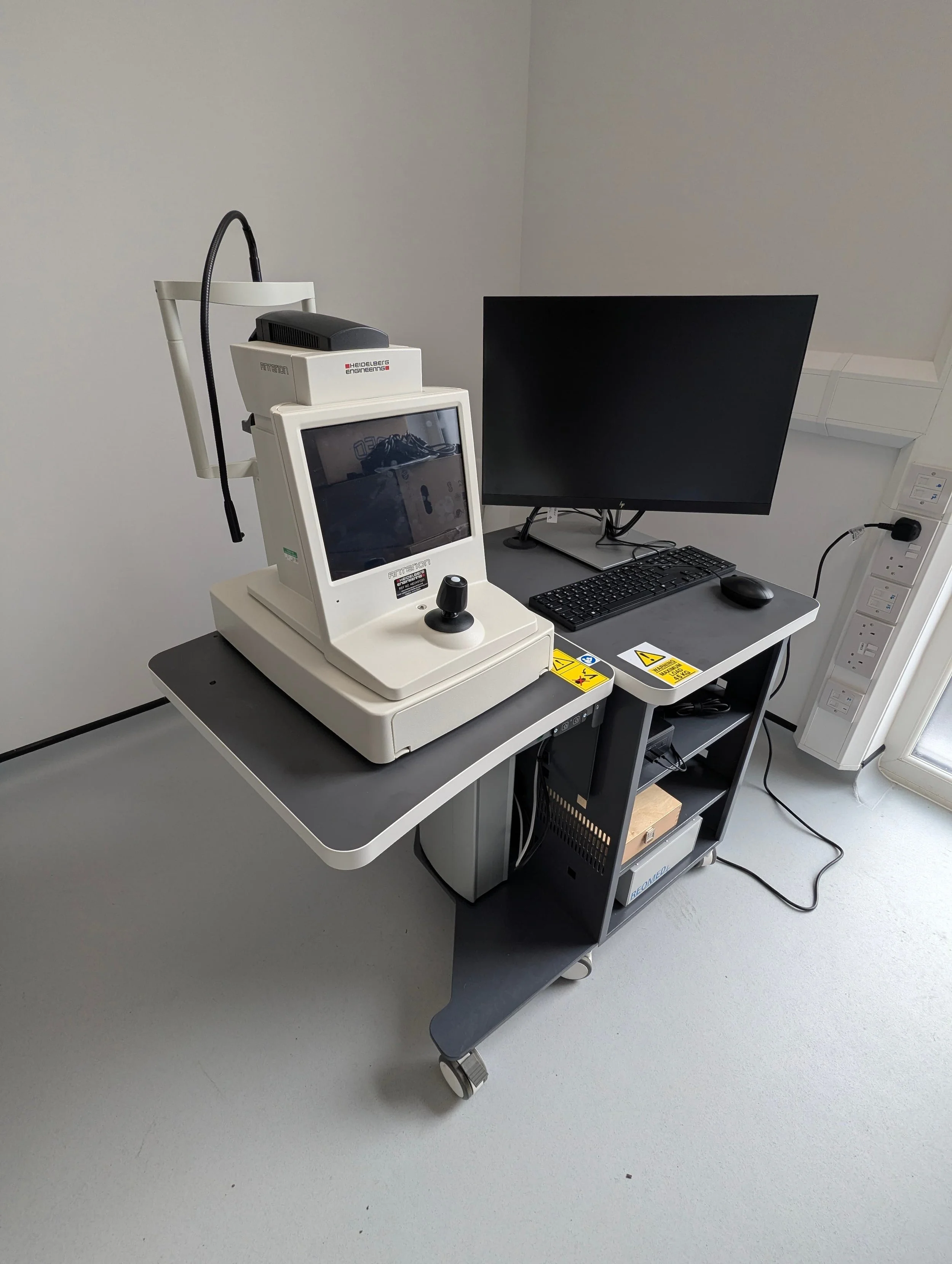
Our Corneal Topographer
We use the ANTERION platform, which combines swept-source OCT technology with high-resolution anterior segment analysis.
This allows:
Detailed cross-sectional imaging of the cornea
Accurate pachymetry and curvature assessment
Visual confirmation of measurements
Consistent, repeatable scans for monitoring over time
Different imaging systems are used across the UK; ANTERION provides high-resolution structural detail alongside reliable measurement data, supporting confident clinical decision-making.
-

Corneal Crosslinking (CXL)
Corneal crosslinking is designed to strengthen the cornea and slow or halt progression in suitable patients.
- Typically recommended when progression is confirmed
- Performed as a day-case procedure
- Aims to stabilise the cornea rather than reverse existing changes
Stopping Keratoconus ProgressionCorneal cross-linking is the only treatment proven to strengthen the cornea and slow or stop progression.
How it works:
- Riboflavin (vitamin B2) eye drops
- Controlled UV light exposure
- Strengthens corneal collagen
- Designed to stop progression
- May improve corneal shape in some casesHelps preserve long-term vision.
-
Why early diagnosis matters
Keratoconus is not just a vision problem, it is a progressive disease.
Glasses and contact lenses improve vision
They do not stop progression
Once progression occurs, the changes to the cornea cannot be reversed.
-
Who should be checked for Keratoconus?
You should consider assessment if you:
Are aged teens to 30s with changing prescriptions
Have been told you have astigmatism that is worsening
Struggle with night driving or glare
Have been referred by your optician
-
When treatment is needed
Not every patient with keratoconus needs immediate cross-linking. Treatment is usually considered when scans show progression, vision is worsening, or the cornea is becoming more irregular. If the condition is stable, regular monitoring may be all that is required.
Keratoconus Specialist in Cheshire
Our Corneal Surgeon
-

Ms Nardine Menassa
CONSULTANT OPHTHALMOLOGIST
FRCOphth · MD (Heidelberg)
Cornea, Cataract Surgery, Dry eye, YAG Laser
Book A Keratoconus Appointment
Our expert team are here to help, talk your through the process and arrange your appointment with one of our specialist Ophthalmologists.
Keratoconus FAQs
What are the early signs of Keratoconus? Common early symptoms include frequent changes in your eye prescription, increasing astigmatism, distorted or blurred vision, and increased sensitivity to light or difficulty with night vision.
Can Keratoconus be cured? There is currently no "cure" that reverses the condition entirely. However, the condition can be effectively stabilised through modern treatments like corneal cross-linking to prevent further vision loss.
Is Keratoconus hereditary? While there can be a genetic component, many cases occur in patients with no family history of the condition. Environmental factors, such as chronic eye rubbing, can also play a role.
Can Keratoconus cause blindness? Total blindness from Keratoconus is very rare. With modern monitoring and timely intervention, the vast majority of patients maintain functional vision and manage the condition successfully.
What is the main goal of treatment? The primary objective is the early detection of progression and the stabilization of the cornea to preserve as much natural vision as possible.
Can Keratoconus be stopped? Yes. Corneal Cross-linking (CXL) is a proven treatment designed to strengthen the corneal tissue, effectively halting the progression of the disease.
Is Cross-linking always necessary? Not necessarily. Many patients with stable Keratoconus are simply monitored. Treatment is typically only recommended when active progression is demonstrated through clinical scans.
Is the Cross-linking procedure painful? Patients may experience some short-term discomfort or a "gritty" sensation for a few days following the procedure, but this is typically well-managed with prescribed eye drops and over-the-counter pain relief.
How long does the stabilization last? Corneal cross-linking is designed to be a long-term solution, providing permanent or very long-lasting stabilization of the corneal structure.
When should I have my eyes checked? You should seek a specialist assessment if you notice your vision becoming increasingly distorted or if your glasses prescription is changing more frequently than usual.
How often will I need scans? The frequency depends on your age and risk level. Initially, scans are typically performed every 3 to 12 months to establish a baseline and monitor for changes.
Do glasses treat Keratoconus? No. While glasses or standard contact lenses can improve your vision, they do not provide any structural support and cannot stop the condition from worsening.
Will I still need glasses or contact lenses after treatment? In most cases, yes. While treatment stabilizes the eye, it does not usually return the cornea to a "normal" shape. However, your vision will be more stable and easier to correct following treatment.